
Materials and choices
Black glass does not diffuse: it reflects. The consequence has to be stated to the client beforehand, not after.
Two glasses, two different trades
Pale glass takes the lamp's light and spreads it: it is a diffuser, and its job is to turn a point source into a surface that can be looked at. Black glass does the opposite — it does not let it through. What you see are the reflections on the surface, and the shape those reflections draw against the pale ceiling.
It is not a degree of the same effect: it is another trade. And the difference does not show on the data sheet, where the two fittings can carry the same source and the same declared output. It shows in use, when somebody switches on and the room stays as it was.
A fitting that occupies instead of lighting
In the lobby there is a chandelier of entirely classical form — twisted arms, cups, candles, drops — but all in black glass. Between white columns and a dark floor it does not light the room: it occupies it. It is a presence, and presence is exactly what was asked for.
Seen from below it is obvious: the arms open radially inside the circular recess, and what reads is a drawing, not a source. The only parts that sparkle are the clear crystal drops, which remain the one place where light actually escapes.
The consequence must be declared beforehand, not after
Here is the point that matters to whoever specifies. Black is a legitimate choice and sometimes the best one, but it carries a consequence that belongs in writing at design stage: that fitting will not do the work. If a hotel expects the lobby chandelier to light, black is the wrong answer, and it gets discovered once the installation is finished.
If instead the brief is a presence, then the job of lighting has to be given to something else — and that something else has to be designed at the same moment, not afterwards. It is the same discipline with which a weight or an overall size is declared: a characteristic that constrains the rest of the project, not an aesthetic opinion.
A dark fitting needs a pale background
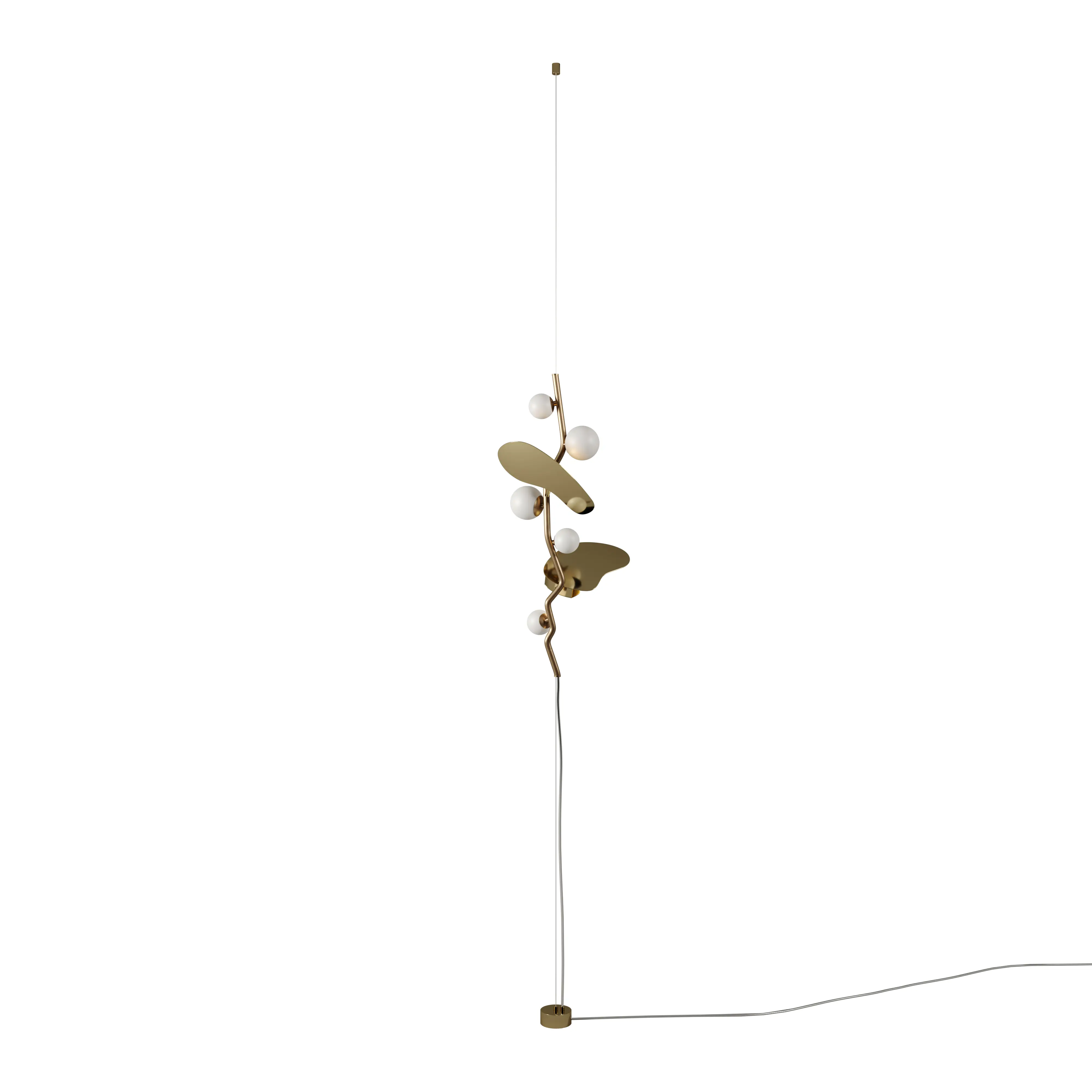
There is a dependency that gets discovered late if it is not looked at early: black reads by contrast, not by any brightness of its own. What makes that chandelier visible is the pale ceiling behind it — the reflections draw a dark figure on a pale ground, and all of its presence comes from there.
The same fitting, under a dark ceiling, would vanish: it would make neither light nor figure. It is one of the rare cases in which an expensive object can become invisible because of a decision taken by somebody else, on another line of the specification.
So at design stage you look at what is behind the fitting from every direction it will be seen from: the ceiling, the back wall, the glazing. If the background changes colour halfway through the project — and in refurbishments it does — the dark fitting is the first to lose out. Here black works for exactly that reason: white columns, a pale ceiling, and beneath it a dark floor that does not compete with it.
The light moves close to the hands
Once the chandelier is relieved of making light, somebody has to take that job on. In the room two small pieces take it: a flexible arm aimed at the pillow, and an etched-glass lamp on the bedside table.
They are the fittings the guest touches, and they are the ones on which the judgement forms. A hotel is remembered for the lobby chandelier and judged on the light by the bed: the first goes into the photographs, the second into the reviews.
The service register, which has nothing to say
In the bathroom an opal cylinder on a chrome bracket has no decorative ambition: it switches on, lights a mirror and disappears. That is the service register, and in a hotel it is needed just as much as the other.
The mistake seen most often is not choosing badly between the two registers: it is designing only one. An all-decorative hotel does not work at seven in the morning; an all-technical hotel is not remembered. The two are drawn together, and the division of labour is written down first.
Etched glass, and why it only reads when lit
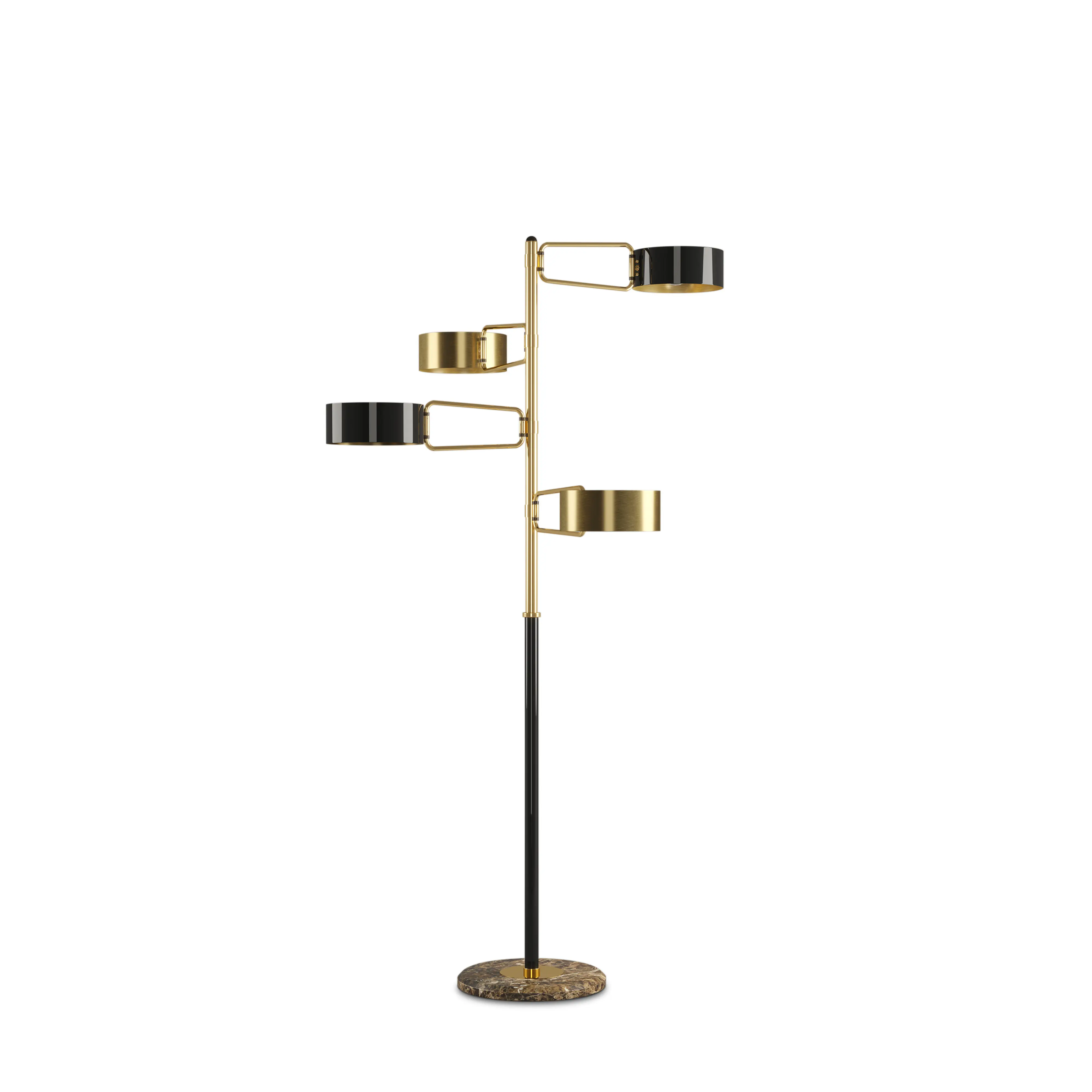
The bedside lamp has an etching on the glass. Switched off it looks almost plain; lit, the etching becomes the drawing — because it is the light passing through that reveals it, not the light falling on it.
It is the black chandelier's principle reversed, in the same hotel: there the glass holds and reflects, here it lets through and shows. Looking at the two side by side is the quickest way to understand why two fittings of the same formal family can do opposite jobs.
How you test glass that does not let light through
On pale glass the sample serves to judge evenness: you look at whether the surface is homogeneous, whether hot spots show, whether the diffuser works. On black glass none of that exists, and the sample has to be looked at for another reason — the reflections.
The way of looking changes too. Dark glass switched off says almost nothing: it says the colour and no more. It has to be lit, and lit at the colour temperature it will have in use, because the reflection of a warm source on a black surface is a different thing from the reflection of a cool one. And it has to be looked at from below, the only level anybody will see it from.
The third thing to bring to the test is the background. A sample hung against a white workshop wall predicts nothing about how it will behave under a beige ceiling or against glazing: what is being judged is not the object, it is the contrast between the object and whatever is behind it.
How much light a lobby really needs
A hotel lobby has a problem the other rooms do not: whoever enters comes from outside, and their eyes are adapting. At eleven in the morning they arrive from full sun, at eleven at night from the dark. One single level does not work at both moments, and the answer is not the average.
So in a lobby the value that counts is not average illuminance: it is the ratio between what is outside and what is inside, and it changes with the hour. An installation that governs it has at least two scenes and changes them on its own. It is exactly the kind of thing you do not add afterwards.
The bedside is the part that gets judged
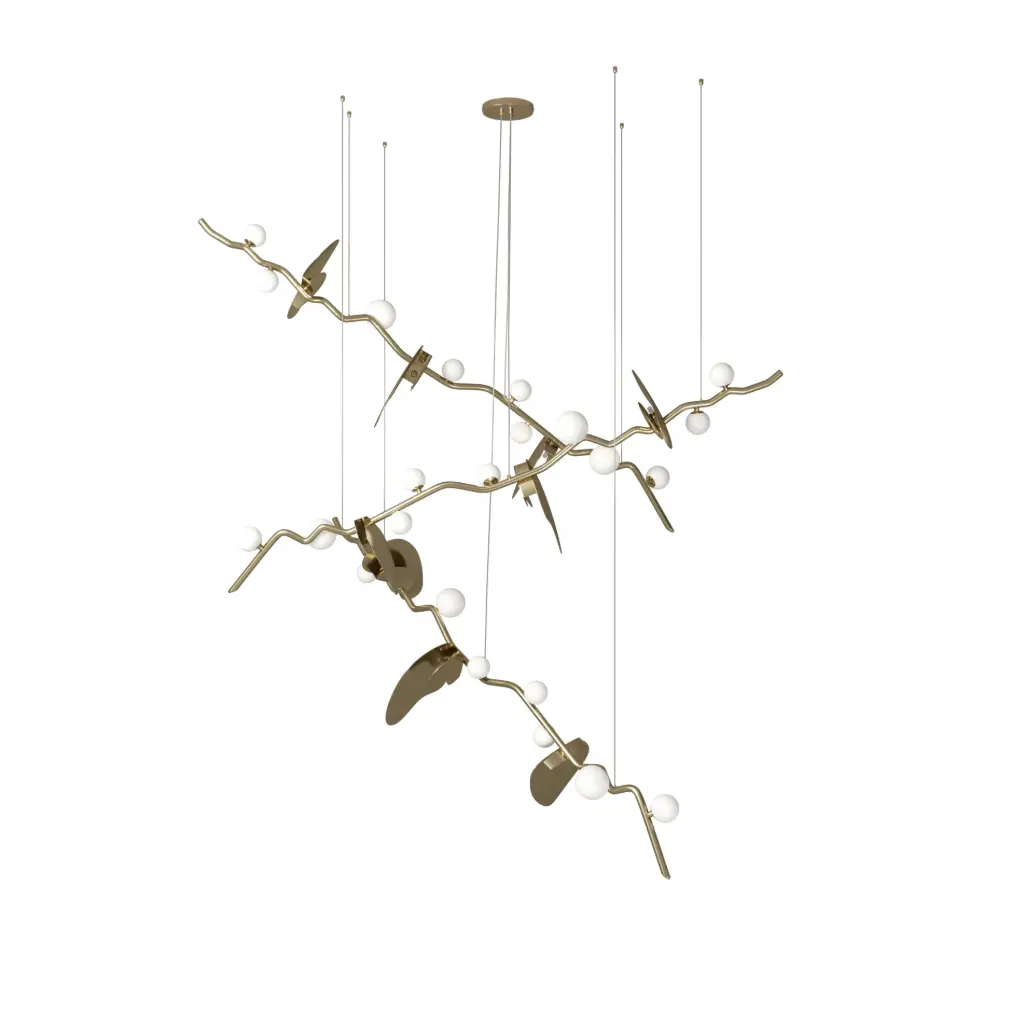
In hotel reviews light appears almost only in two forms: "you could not read" and "the light was in your eyes". Neither is about the lobby. They are about the flexible arm over the pillow and the lamp on the bedside table, that is, the two smallest pieces in the supply.
A rule follows that is worth more than the budget: if something has to be cut, it is not cut at the bedside. A slightly less impressive chandelier is noticed by the designer; a reading light that does not aim is noticed by everybody who sleeps in that room, and they write it down.
The bathroom, and why the fitting has to disappear
In a bathroom light has one very precise job: to render a face in a mirror. It is not a decorative job, and it is the one place in the hotel where the right fitting is the one nobody looks at.
The technical criterion is direction: a source above the mirror digs shadows under the eyes, sources at the sides fill them. The practical criterion is another and always gets forgotten — it gets cleaned. An opal cylinder on a chrome bracket comes apart and washes; a fitting with slots and corners, in the same place, is cloudy after a year.
Two registers in one specification
A hotel needs fittings that are looked at and fittings that are used, and most specifications describe only one of them well. The way to hold them together is banal and almost nobody does it: declare, for each fitting, which of the two registers it belongs to.
One line changes everything else. On a presence fitting you write the finish, the sample and the view it is judged from; on a service fitting you write the illuminance, the rendering and how it is cleaned. Asking the same things of both means writing a specification that neither of them meets well.
Who holds the two halves together
The commonest defect in a project like this is not technical: it is that the two halves are bought by different people. The presence piece is chosen by whoever looks after image, the service piece by whoever looks after cost, and the two choices do not meet until installation.
The remedy is a single document containing both, in the same language and the same units. It does not need to be long: it needs one person to have read all of it, and that person to be able to answer the question "in this room, who makes the light?".
What to put in writing before choosing the glass
Before settling a finish it is worth fixing what has to happen in that room. It is a few lines, and they are the ones that separate a specification from a catalogue:
- how much light has to reach the floor, and from which fittings
- which fitting is presence and which is service — declared, not implied
- how the glass is tested: physical sample and lit, at the real colour temperature
- who switches what, and with how many separate controls
- what gets cleaned, how often, and who can reach it
| What it does | Pale glass | Black glass |
|---|---|---|
| Light that passes | plenty, diffused | almost none |
| What you see | a luminous surface | reflections and a figure against the ceiling |
| What the effect depends on | the source | the background behind the fitting |
| If the ceiling is dark | it still works | it vanishes |
| Who lights the room | the fitting itself | something else, designed alongside |
| What the sample judges | evenness | the reflections, with the source on |
The sample is looked at lit
Dark glass switched off says very little. The useful test is with the source on and at the colour temperature it will have in use: that is where you see how much it reflects and how much it lets through, and no data sheet tells you.
The clear drops are not an ornament
On an entirely dark fitting they are the one place where light escapes. Removing them to simplify — which value engineering often proposes — changes the fitting, it does not economise on it.
Three lights, three controls
The person sleeping and the person reading do not want the same light at the same moment. The arm over the pillow, the bedside lamp and the bathroom light belong on separate controls: it costs at installation and repays itself in reviews.
The whole project
NH Excelsior in Siena: black blown glass in the lobby, and precise service light where people read and wash — two trades in one hotel.