
Coherence of design
Ten fine, unconnected fittings make ten photographs. One motif, repeated at different sizes, makes a hotel.
What fretwork is, and what it does to light
What we call fretwork is sheet metal pierced to a geometric pattern. Its peculiarity is that it does not behave as a diffuser: the light does not come out spread, it comes out through the holes, and what you see is not the lit fitting but the pattern it casts on the surfaces around it.
That changes how it has to be assessed. Fretwork is judged by looking at the floor and the walls, not at the fitting: its performance is the shadow it makes, and that changes with the distance from the surface. The same piece standing in a courtyard and hung from an arch makes two different patterns, and both have to be looked at beforehand.
One motif, from the forecourt to the table
At Al Najada the same principle returns at three very different sizes: in the tall columns of the courtyard, in the lanterns hung beneath the arches, in the drum fitting above a table for eight. The dimension changes, the principle does not.
It is the choice that makes a hotel recognisable even in a close-up photograph. Ten fine, unconnected fittings make ten separate photographs; one motif, declined, makes a place — and whoever photographs it, without knowing, always photographs the same idea.
The columns do two jobs, depending on the hour
In the courtyard the perforated columns are as tall as a person and a half and stand among the planters. At night they are the light of the space. By day they become furniture: they mark the routes between the terrace tables and cast shadows on the paving.
It is the criterion that matters most in a hotel open at every hour: a luminous object that does not exist at midday is an object working half the time it was paid for. A technical fitting switched off is a hole in the ceiling; a column switched off is still a column.
The facade is not washed
At night there is no floodlight aimed at the building. There are points at ground level, and the arches lit one by one. It is a choice that runs opposite to the commonest one — flooding the facade with light — and gives a different result: the building is recognised by its geometry, not by its brightness.
It also has two practical consequences worth counting: lighting by elements consumes less than washing a surface, and a failed fitting is far less noticeable when the light is spread over many small points instead of concentrated in a few large ones.
Where people eat, the light looks up
In the restaurant the lanterns do not hang over the tables: they are mounted on the piers, between the blue arches. What reaches the table is therefore indirect light, and the white cloths do not turn into mirrors.
It is a mistake seen often and paid for every evening: a source above a white surface turns it into a reflector aimed at the face of whoever is sitting there. The remedy is not lowering the output — which kills the room — but moving the source off the axis of the table, and that is a decision about position, not about product.
The double drum in the private room
In the private room the same idea takes another form: a drum fitting tight to the ceiling, doubled and perforated, sending as much up as it sends down.
Sending light towards the ceiling in a dining room is not waste: it is what stops the room closing over people's heads. A room lit only downwards has a black ceiling, and a black ceiling lowers the room even when it is high.
Fretwork is cleaned differently
A perforated fitting has an inner surface nobody sees and which collects dust. It is not a fault: it follows from the geometry, and it belongs in the cleaning schedule with everything else. A fabric shade is dusted; pierced sheet metal has to be blown out or washed, and the time it takes is not the same.
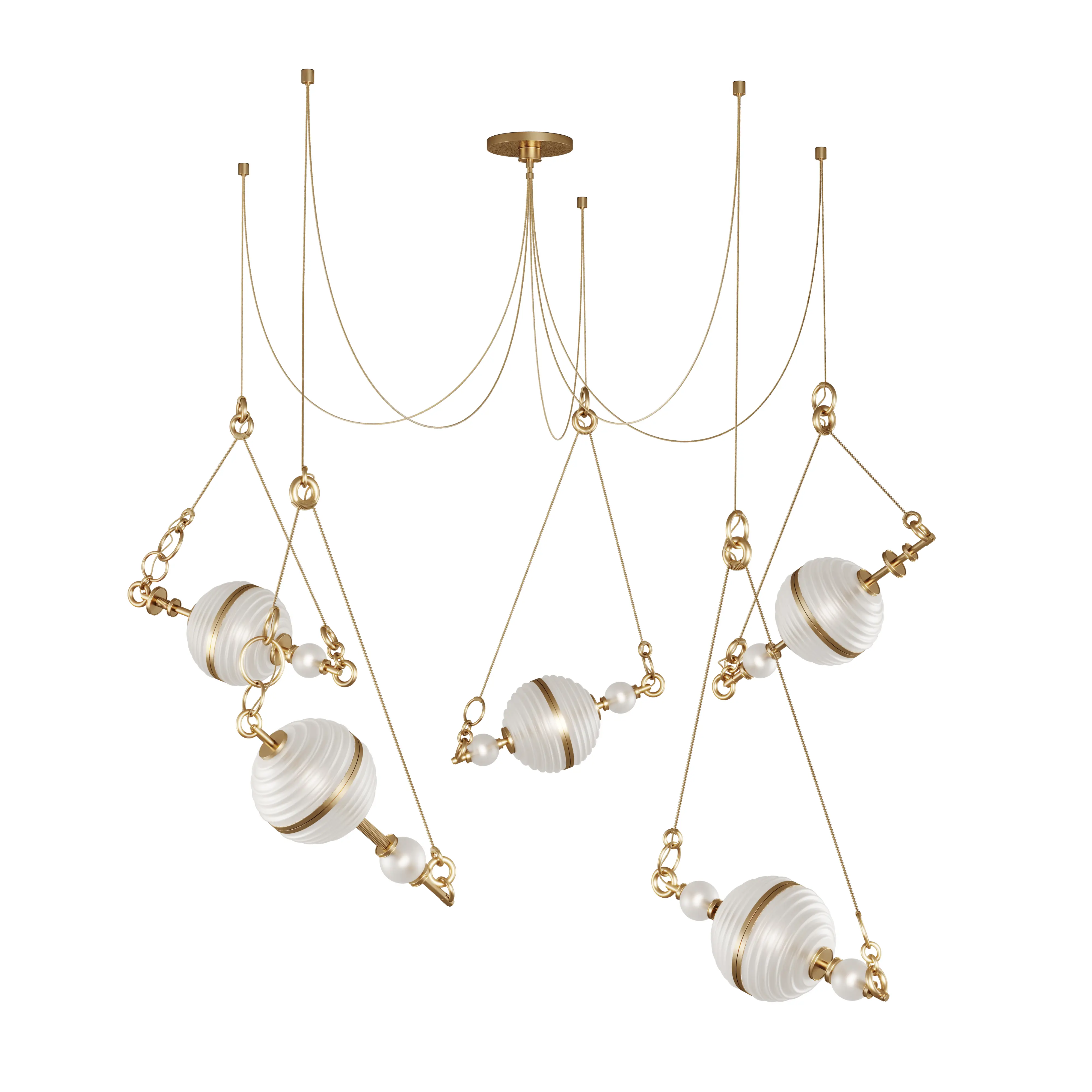
On a floor-standing fitting the question moves further: how well does that edge hold up at the height where trolleys pass? In a courtyard with tables and service, a luminous object as tall as a person and a half gets knocked — and the finish chosen has to withstand not only the light but the traffic.
What one motif costs, and what it saves
Keeping to one motif costs in design: every size has to be redrawn, because an enlarged geometric pattern almost never works — the ratio of solid to void changes, and with it the shadow. What it saves comes afterwards, and it is nearly everything:
- fewer codes, so fewer data sheets, fewer lead times and less stock
- a single finish to keep under control across batches
- spares that serve several families, not one piece only
- a hotel that is recognisable in a close-up photograph
Fretwork is designed by looking at the shadow, not the fitting
What makes fretwork difficult is that its result is not on the object: it is on the surfaces around it. It is designed by looking at the floor and the walls, and that changes the way tests are made.
The shadow pattern depends on three things together: the ratio of solid to void in the metal, the distance between source and holes, and the distance between fitting and surface. Change one and everything changes — which is why a test made half a metre from a wall says nothing about how it will be three metres from a floor.
A practical rule follows for whoever orders: ask for the sample to be tested at the real distance, and ask for a photograph of the shadow, not of the fitting. It is the only image that describes what is being bought.
Why an enlarged geometry stops working
A geometric pattern doubled does not double its effect: it changes the ratio between solid and void, and with it the amount of light that escapes and the scale of the cast shadow. A two-metre column with the same motif as a forty-centimetre lantern draws something completely different.
That is why in a family every size is redrawn, and redrawing costs. It is the line that disappears first when a budget is squeezed, and it is the one that decides whether the three sizes will look like relatives or merely like catalogue neighbours.
Lighting by elements instead of washing a facade
Lighting the arches one by one costs more design and less power than a floodlight washing the facade. The first result is visual: the building reads by its geometry rather than by its brightness, and at night it resembles itself rather than a backdrop.
But there are two practical consequences that justify the choice on their own: it consumes less for the same effect, and a failed fitting is far less noticeable when the light is spread over many small points. On an installation that has to work every evening, the second is worth more than the first.
Maintaining a pierced fitting
Pierced sheet metal has an inner surface nobody sees, and it collects dust and insects. It is not a fault, it follows from the geometry — and it belongs in the cleaning schedule, because dust on the edges of the holes softens the shadow pattern before it even reduces the light.
The question to ask in the quotation is simple: does it open? A fitting that opens is washed in an hour; a closed one is washed from outside, which is to say badly. On a hotel with dozens of pieces, the difference between the two is an annual budget line, not a detail.
Gold is not a colour: it is a surface
A gilded finish is not chosen on a colour code, because what you see is not the colour but the way the surface reflects. Two gildings of the same tone, one brushed and one polished, make two different objects in a courtyard at sunset.
So the same rule as other finishes applies, with one extra reason: gold ages, and it ages differently outdoors and indoors. Asking what it will look like in three years, and seeing an aged sample if one exists, is the only way to buy what you will actually see.
What holds a project together when the variations arrive
On a long job variations always arrive: a space changes use, a room is divided, a table moves. A project held together by a list of products falls apart at that point — because there is no criterion for choosing the new piece.
A project held together by a motif holds, because the criterion exists and is written: whatever is needed is made in that family and at one of those sizes. It is the real economic advantage of coherence, and it only shows at the third variation — that is, when nobody remembers any more who insisted on it.
What to ask about a project held together by a motif
The useful questions are not about the drawing, which can be seen. They are about what happens when the drawing gets repeated:
- how the solid-to-void ratio changes from one size to another
- at what distance from the surface the shadow pattern was tested
- how many fittings stay visible by day, and with what form
- whether the finish is fixed on a physical sample that is kept
- who keeps the list of families, and where
| Where | The size | What it has to do |
|---|---|---|
| Courtyard | columns as tall as a person and a half | the light at night, furniture by day |
| Beneath the arches | hanging lanterns | mark the route without glaring |
| Restaurant | lanterns on the piers | indirect light on the table |
| Private room | doubled drum fitting | send as much up as down |
| Facade | points at ground level, arches one by one | let the geometry read, not the brightness |
| Every size | redrawn, not scaled | the solid-to-void ratio changes with the size |
Fretwork is tested on the floor
The only way to know what it will do is to light it at the real distance from the surface and look at the shadow, not the fitting. A sample hung half a metre from a wall says nothing about how it will be at three.
Enlarging a pattern does not preserve it
Doubling the size changes the ratio of solid to void, and with it the amount of light that escapes. Every size in a family has to be redrawn, not scaled: it is the part of the work that does not show and that holds the result together.
The photographs are the ones that exist
The images of this project are small, and the page serves them at their real size instead of enlarging them: an inflated image is recognisable, and it takes credibility away from everything else on the page.
The whole project
Al Najada, Doha: gilded perforated columns in the courtyard, lanterns mounted on the piers beneath the arches and drum fittings in the rooms.